

Intrusion Protection Systems
Next-Gen Defense: Why AI-Driven Intrusion Prevention Systems Are No Longer Optional
Participating in the largest and most diverse Cyber Threat Intelligence network on earth
In today’s hyper-connected digital landscape, the attack surface is expanding faster than any traditional security model can manage. The days of relying on perimeter walls and static rule sets are long gone. Enter Intrusion Prevention Systems (IPS)—the proactive, real-time sentinels that detect, block, and neutralize threats before they breach your environment.
But not all IPS platforms are built for the modern threat landscape. Here’s why automation, intelligence, and architecture matter more than ever.
The Limits of Human-Only Oversight
Cyber threats today are automated, polyglot, and highly adaptive. Attackers operate 24/7, deploy sophisticated evasion techniques, and exploit micro-second windows that human analysts simply cannot track manually. Relying solely on human monitoring creates critical blind spots:
Alert fatigue overwhelms security teams with false positives
Response latency leaves systems vulnerable during investigation
Scale limitations prevent coverage across hybrid, cloud, and edge environments
Human expertise remains irreplaceable—but it must be amplified, not burdened.
How AI & Machine Learning Transform IPS
Modern, machine-driven IPS platforms process terabytes of network telemetry in real time. By leveraging behavioral analytics, threat correlation, and continuous model training, they:
Detect zero-day exploits and novel attack patterns
Adapt instantly to emerging threat vectors
Automate containment with precision rules (blocking, rate-limiting, challenges)
Drastically reduce false positives through contextual scoring
The result? Faster mean-time-to-detect (MTTD) and mean-time-to-respond (MTTR), without scaling headcount.
The Power of Human + Machine Synergy
Automation doesn’t replace security professionals—it empowers them. While machine-driven IPS handles continuous monitoring, pattern recognition, and instant remediation, your team is freed from reactive triage to focus on:
Strategic threat hunting & purple teaming
Architecture hardening & compliance mapping
Incident response & post-breach forensics
Proactive policy development & threat modeling
This collaboration creates a resilient, adaptive security posture that evolves alongside the threat landscape.
Join the Largest Crowd-Sourced Defense Network on Earth
At the core of this evolution is CrowdSec CTI—a cutting-edge, open-source, community-driven Intrusion Prevention & Cyber Threat Intelligence platform. As an official Ambassador for CrowdSec CTI, Triii Technologies LLC highly recommends integrating it into your production stack.

Why CrowdSec Stands Out
🌍 Massive Intelligence Sharing: Taps into a globally distributed network of contributors, corporations, and ISPs for real-time threat feeds
🔧 Modular & Extensible: Plugins for Nginx, Apache, Fail2ban, WAFs, SIEMs, and cloud APIs
⚡ Lightweight Footprint: Runs efficiently on commodity hardware or containerized environments
🛡️ Zero-Trust Ready: Designed for modern, distributed architectures without single points of failure
Easy Deployment for Unix-Based Production Servers
Running a public-facing application, API, or database on a Unix-based OS? Getting started is straightforward:
Install the crowdsec agent on your host
Configure cscli to pull intelligence lists & install relevant scenario packs
Enable plugins for your web server or firewall stack
Monitor dashboards & adjust sensitivity thresholds as needed
Full installation guides, Helm charts, and systemd templates are available in the official CrowdSec documentation.
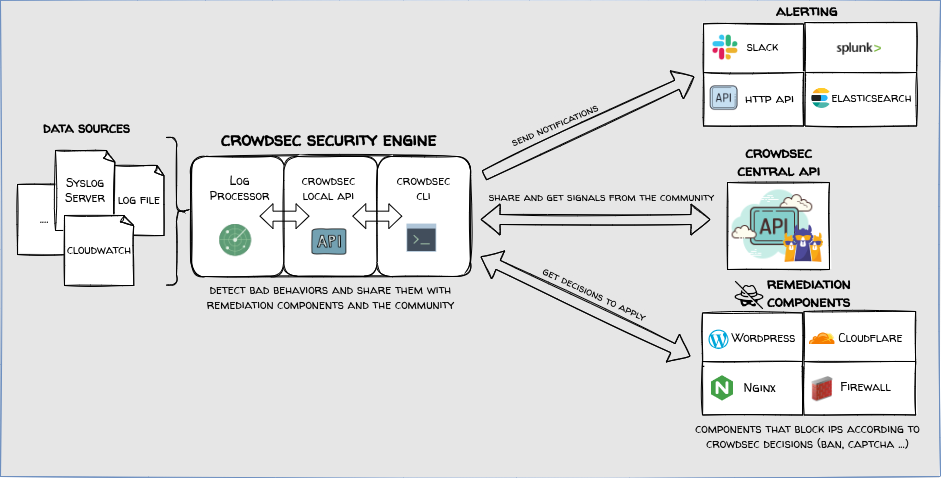
How Remediation Flows in CrowdSec CTI
(Refer to the illustration below)
The diagram outlines how CrowdSec transforms raw telemetry into actionable defense. When malicious activity is detected:
Intelligence Correlation: The agent cross-references IPs, user-agents, and request patterns against the crowd-sourced CTI database
Threat Scoring: Behavioral anomalies are weighted using machine learning models & community reputation data
Automated Remediation: Depending on policy, the system triggers rate limiting, CAPTCHA challenges, IP blocking, or forwarding to external WAFs/firewalls
Feedback Loop: Blocked or challenged events are shared back into the network, hardening defenses globally
This closed-loop architecture ensures that what harms one system is instantly countered across the entire ecosystem.
Ready to Future-Proof Your Infrastructure?
Explore our curated deployment playbooks, architecture best practices, or connect with our security engineering team to tailor CrowdSec CTI to your environment.